June 23, 2026
Custom Metal Stamping Parts for Automotive Applications
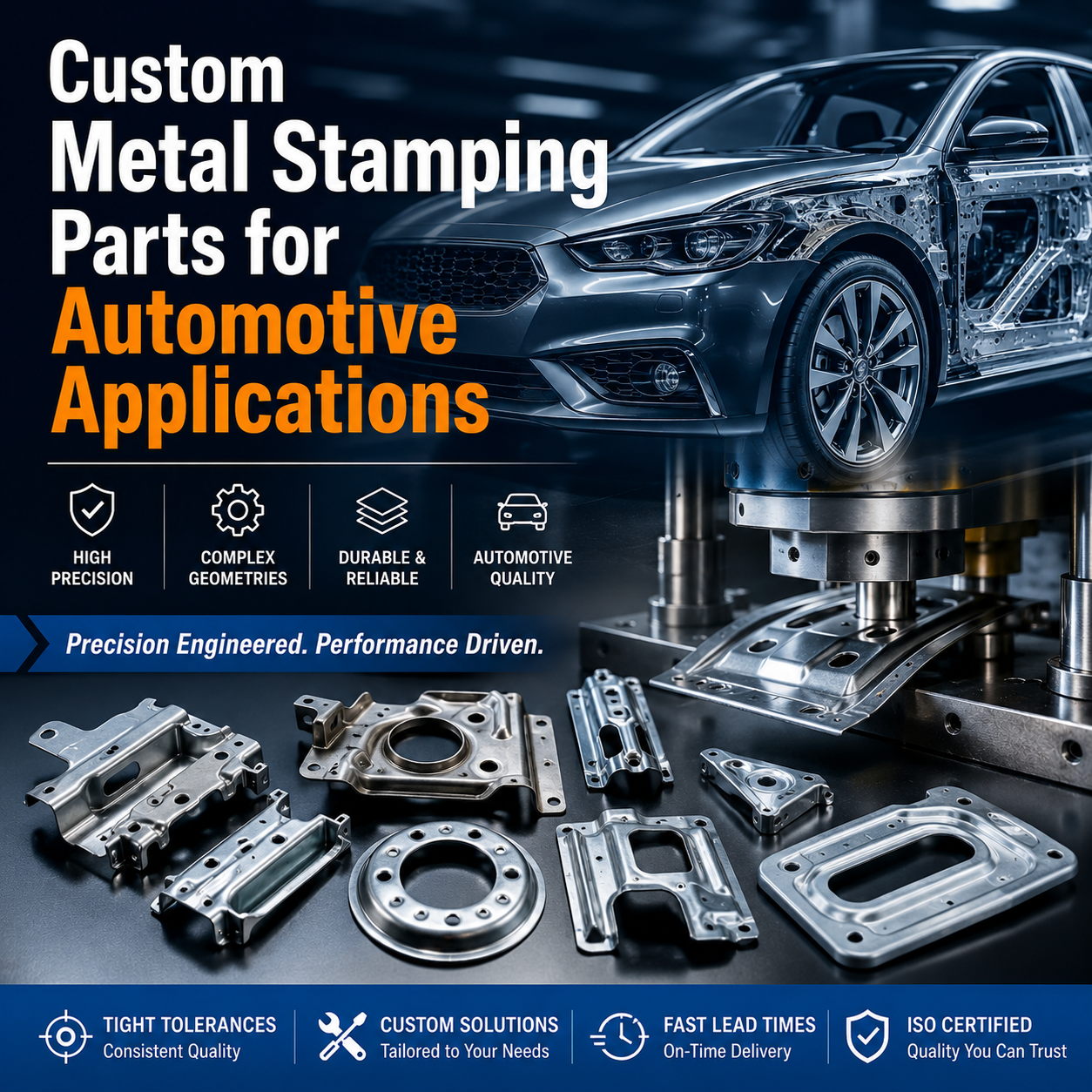
A concise sourcing guide for procurement professionals and design engineers
Table of Contents
Introduction
Market Overview
Key Application Areas
Materials
Manufacturing Processes
Quality Standards
Supplier Selection
Emerging Trends
Conclusion
Introduction
A modern vehicle contains thousands of stamped metal components — body panels, chassis brackets, engine mounts, and now battery busbars and motor laminations for EVs. These are not standard off-the-shelf parts. Each is custom-engineered for a specific vehicle platform.
Custom metal stamping remains the most cost-effective method for producing high-volume automotive parts. But the shift to electric vehicles and lightweighting mandates is changing what buyers need from their stamping suppliers. This guide covers the essentials: applications, materials, processes, quality standards, and supplier selection.
Market Overview
The global automotive metal stamping market was valued at approximately USD 92 billion in 2025 and is projected to reach USD 142 billion by 2034, at a CAGR of about 5%. Asia-Pacific dominates with 35% market share, followed by Europe (28%) and North America (25%).
Key growth drivers include rising vehicle production in emerging economies, safety regulation evolution, and the accelerating EV transition, which creates entirely new stamped part categories — battery enclosures, busbars, motor laminations — that did not exist a decade ago.
Key Application Areas
Body-in-White and Exterior Panels — Hoods, doors, roofs, floor pans. Class A surfaces requiring flawless finish. Large presses (1,000+ tons) are typical.
Chassis and Suspension — Control arms, subframes, cross-members. High-strength steels and aluminum, heavy-tonnage presses (200–1,200T).
Powertrain and Engine — Mounting brackets, oil pans, heat shields. High-temperature materials, tighter tolerances.
Structural Reinforcements — B-pillars, door beams, crash boxes. Often ultra-high-strength steel (UHSS) via hot stamping.
Interior and Trim — Seat frames, latch mechanisms, brackets. Moderate tolerances, often with assembly.
EV-Specific Components — Battery enclosures, busbars (copper/aluminum), motor laminations (electrical steel), thermal management plates. Fastest-growing category.
Materials
Material | Strength | Formability | Typical Use |
Low-carbon steel | Low (200–300 MPa) | Excellent | Brackets, interior non-structural |
AHSS (DP, TRIP) | High (500–1,200 MPa) | Good | Chassis, crash structures |
UHSS (hot-stamped) | Very high (1,200–1,800+ MPa) | Poor cold / Good hot | B-pillars, door beams |
Aluminum (5000/6000) | Moderate (150–350 MPa) | Moderate | Body panels, battery enclosures |
Copper alloys | Moderate | Fair | Busbars, terminals, connectors |
Steel remains dominant for cost and supply-chain familiarity. Aluminum is preferred for lightweighting, especially in EVs. Copper is essential for electrical applications but expensive and requires careful handling.
Manufacturing Processes
Progressive Die Stamping — Most common for high-volume small to medium parts. A single strip moves through multiple stations; each press stroke produces a finished part. Low per-unit cost, excellent consistency.
Transfer Die Stamping — For larger parts. Individual blanks are transferred between stations. Suitable for deep draws and complex forms. Presses up to 1,200 tons.
Hot Stamping (Press Hardening) — For UHSS. Blanks heated to ~900°C, formed in cooled dies, quenched. Achieves >1.8 GPa with minimal springback. Used for B-pillars, door beams, crash components.
Secondary Operations — Tapping, deburring, heat treatment, plating, welding, assembly. Most stamped parts require some finishing.
Simulation and Automation — FEA modeling predicts cracking, wrinkling, springback before tool steel is cut. Robotic stamping and AI-driven quality control reduce cycle times by up to 30%.
Quality Standards and Certifications
IATF 16949:2016 — The global automotive quality standard. Required for any Tier One supplier. Includes PPAP, FMEA, control plans, capability studies.
ISO 9001:2015 — Baseline quality management. ISO-certified stampers report ~99% on-time delivery.
PPAP (Production Part Approval Process) — Level 3 documentation is standard: dimensional results, material certs, capability studies, control plans.
Traceability — Full lot control from steel mill heat number to finished part. Enables recall management.
Suppliers lacking IATF 16949 should not be considered for production automotive work. For prototypes or low-volume non-safety parts, ISO 9001 may suffice.
Supplier Selection Criteria
Criterion | What to Look For |
Press capacity | Tonnage range matching your part size (5T to 1,200T+) |
Process capabilities | Progressive, transfer, or hot stamping |
In-house tooling | Design, simulation, build, try-out |
Secondary ops | Tapping, welding, heat treat, plating |
Quality certs | IATF 16949 minimum |
PPAP capability | Level 3 documentation |
Materials experience | Mild steel, AHSS, aluminum, copper |
Lead time | 4–8 weeks simple tooling; 10–16 weeks complex |
MOQ | Varies; some accept 500–1,000 pieces; Tier One typically 50k+ annual |
Ask for references from current automotive customers. Review case studies of similar parts. The best supplier relationships are partnerships, not transactions.
Emerging Trends
EV Transition — Battery enclosures, busbars, and motor laminations are new high-growth categories. Each demands specific tolerances and materials.
Lightweighting — Every 10% weight reduction improves fuel efficiency by 6–8% (or extends EV range). Stampers must master AHSS (cold-formable >1.2 GPa) and aluminum.
Hot Stamping Growth — UHSS parts are essential for safety cages in EVs where battery weight increases overall mass. Aluminized 30MnB5 steel (1.8+ GPa) is widely used.
Reshoring — Tariffs and supply chain disruptions are pushing stamping production back to domestic suppliers, especially in North America and Europe.
Sustainability — Automakers require suppliers to document carbon footprints and increase recycled content.
Automation — AI-driven quality control, inline vision systems, and predictive maintenance are becoming standard in high-volume lines.
Digitalization — Integrated digital twins and closed-loop controls move from pilot lines to mainstream operations, enabling zero-defect delivery.
Conclusion
Custom metal stamping parts are everywhere in modern vehicles. The industry is changing rapidly — driven by EVs, lightweighting, and higher quality standards.
For procurement professionals, the formula is straightforward: understand your part requirements (material, volume, tolerance, application), then find a supplier whose capabilities align precisely. Not every stamper can handle AHSS or aluminum. Not every stamper has hot stamping lines. Not every stamper is IATF 16949 certified.
Evaluate systematically. Request PPAP documentation. Build relationships early. The suppliers who win long-term partnerships are those that combine strong stamping capabilities with engineering support, quality discipline, and transparent communication.
This guide is for automotive procurement, engineering, and quality professionals. Market data as of 2025–2026. Always verify supplier certifications before ordering.