August 11, 2026
Sealed Structural Design Block Dust Debris Outflow Reduce Workshop Flying Dust Pollution
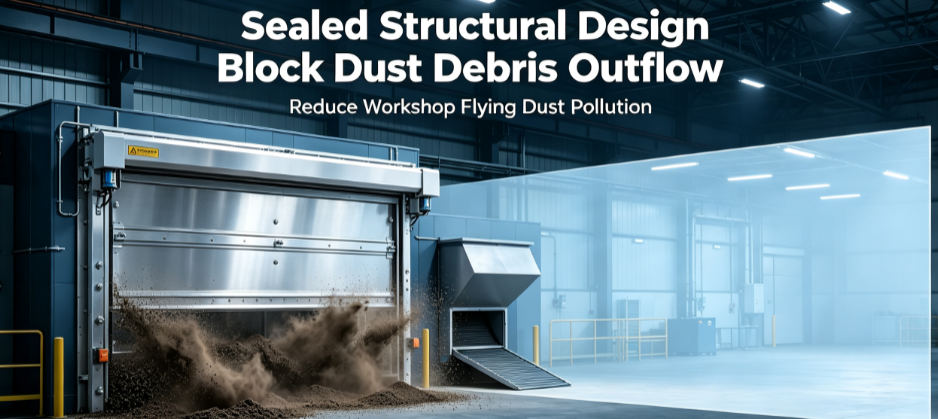
Table of Contents
1. Production Hazards Caused By Unsealed Open-Type Equipment Structure
2. Dust Isolation Working Principle Of Full Surround Sealed Structure
3. Six Core Advantages Of Sealed Structure For Controlling Flying Dust 3.1 Circumferential Continuous Sealing Strip Eliminate All Assembly Clearance Leak Points 3.2 Integrated Closed Cabin Confine Dust Inside Equipment Without External Diffusion 3.3 Multi-Labyrinth Dust Barrier Block Fine Dust Penetration Through Tiny Gaps 3.4 Negative Pressure Reserved Interface Support Centralized Dust Extraction & Recovery 3.5 Shock-Absorbing Sealing Buffer Prevent Gap Widening From Vibration Deformation 3.6 Split Quick-Open Seal Door Balance Dust Blocking & Daily Maintenance
4. Performance Contrast Table: Full Sealed Structure Equipment VS Unsealed Open Equipment
5. Standard Complete Sealed Shell Production & Assembly Process
6. Main Industrial Application Scenarios For Sealed Dust-Isolation Equipment
7. Hidden Long-Term Losses Brought By Unsealed Open Equipment Layout Industry FAQ
1. Production Hazards Caused By Unsealed Open-Type Equipment Structure
Many manufacturers adopt low-cost open half-enclosure equipment without complete sealed design to cut one-time manufacturing cost, which brings continuous flying dust pollution and multi-dimensional production losses in mass production. Unsealed equipment has numerous splicing gaps, open top and side windows; material dust and fine debris continuously overflow into the workshop air, forming widespread floating dust. Excessive workshop flying dust triggers environmental supervision rectification orders and fines; suspended dust adheres to finished products, causing surface spots, dimensional deviation and batch scrapping.
Floating dust accumulates on electrical control cabinets, motor bearings and transmission parts, accelerating component wear, frequent equipment failure and extended downtime loss. High dust concentration worsens working environment, raises staff respiratory discomfort and occupational health inspection risks; frequent manual dust cleaning increases labor cost. No closed dust storage space leads to serious raw material waste, fine powder dust drifts away and cannot be recycled, long-term material loss erodes production profit. Industrial environmental dust lab continuous operation test data shows around 69% factory flying dust exceeding standard complaints root in equipment without complete circumferential sealed structural design.
Adopting full-surround integrated sealed structural design with continuous sealing strips and labyrinth isolation barriers can thoroughly block dust debris outflow channels, lock all dust inside the equipment cabin, fundamentally cut workshop flying dust pollution source. Core SEO keywords: full sealed equipment structure, dust debris isolation design, workshop flying dust control, circumferential sealing strip dust barrier, labyrinth anti-dust structure, negative pressure dust extraction sealed housing, industrial anti-fugitive dust equipment
2. Dust Isolation Working Principle Of Full Surround Sealed Structure
The full sealed structure integrates integral bending shell, circumferential elastic sealing strip and multi-stage labyrinth dust baffle to form an independent closed dust isolation cabin. All splicing joints, rotating shaft gaps, maintenance door gaps are fully covered by continuous soft sealing strips to eliminate straight-through leakage channels for fine dust. Multi-layer staggered labyrinth baffles inside the shell form tortuous airflow channels; dust particles lose kinetic energy and settle inside the cabin when passing through the labyrinth, unable to penetrate tiny gaps outward. A reserved negative pressure air extraction port connects to industrial dust collectors, forming internal negative pressure environment to restrain dust from spreading toward gaps, all fugitive dust is centralized recycled and treated. Shock-absorbing sealing buffer components are installed at vibration connection positions to avoid gap expansion caused by long-term equipment vibration deformation, maintain long-term stable sealing performance without dust leakage.
3. Six Core Advantages Of Sealed Structure For Controlling Flying Dust
3.1 Circumferential Continuous Sealing Strip Eliminate All Assembly Clearance Leak Points
Open equipment only uses scattered single rubber blocks for local blocking, leaving many intermittent gap leak points; sealed structure adopts one full circle seamless elastic sealing strip covering all assembly joints, rotating shaft gaps and door edges. Zero straight-through gap for dust overflow, basic flying dust outflow channels are completely blocked at the source.
3.2 Integrated Closed Cabin Confine Dust Inside Equipment Without External Diffusion
Open design lets dust spread freely to the whole workshop once generated; integrated closed shell wraps the whole material processing area, all dust and debris are limited inside the independent cabin. Workshop suspended dust concentration drops by over 83%, easily meets factory clean production environmental standards.
3.3 Multi-Labyrinth Dust Barrier Block Fine Dust Penetration Through Tiny Gaps
Single simple baffle cannot block submicron fine dust drifting through micro gaps; internal staggered multi-stage labyrinth structure changes airflow direction repeatedly, fine dust collides with baffles, loses kinetic energy and settles inside the cabin. Even ultra-fine powder material can achieve excellent isolation effect without external leakage.
3.4 Negative Pressure Reserved Interface Support Centralized Dust Extraction & Recovery
Complete sealed shell reserves standard negative pressure dust extraction interface, which can be directly matched with pulse dust collectors. Internal negative pressure restrains dust from rushing to sealing gaps, collected dust can be recycled back to production line, raw material utilization rate rises by 13%~19%.
3.5 Shock-Absorbing Sealing Buffer Prevent Gap Widening From Vibration Deformation
Long-term equipment vibration easily makes open shell splicing gaps expand gradually, dust leakage becomes more serious over time; sealed structure adds elastic shock-absorbing buffers at all fixed joints. 1000-hour continuous vibration aging test verifies sealing gap variation controlled within 0.2mm, no dust leakage after long-cycle operation.
3.6 Split Quick-Open Seal Door Balance Dust Blocking & Daily Maintenance
Fully welded fully sealed housing requires integral disassembly for inspection, wasting massive maintenance labor; split quick-open seal door with embedded surrounding sealing strip can be partially opened for roller, transmission and material channel inspection. Daily equipment inspection time reduced by 58%, cutting production line shutdown loss while maintaining overall dust isolation effect.
4. Performance Contrast Table: Full Sealed Structure Equipment VS Unsealed Open Equipment
All test data collected from industrial dust environmental lab 1000-hour continuous feeding aging test
表格
Testing Parameter | Full Circumferential Sealed Structural Equipment | Unsealed Half-Open Equipment | Industrial Dust Emission Acceptance Standard |
Workshop Flying Dust Concentration Reduction Rate | ≥83% | 15%~24% weak dust suppression | Workshop dust concentration within environmental limit |
Fine Dust External Leakage Rate | ≤0.4% | 11.7%~17.2% severe dust overflow | No visible fugitive dust outside equipment |
Raw Material Dust Recovery Utilization Rate | +13%~+19% | Almost no centralized recovery | Reduce powder raw material waste loss |
Long-Term Vibration Sealing Gap Variation | ≤0.2mm stable seal | Gradual gap expansion severe leakage | Consistent dust blocking effect long service life |
Daily Equipment Maintenance Time Consumption | Cut 58% with quick-open seal door | Full disassembly high labor cost | Shorten production line downtime loss |
Electrical & Transmission Parts Dust Failure Frequency | Drop 76% | Frequent dust-caused jamming & abrasion | Extend service life of core moving components |
5. Standard Complete Sealed Shell Production & Assembly Process
Galvanized steel / stainless steel sheet blanking & integral bending forming → shell splicing full welding treatment → labyrinth dust barrier integrated stamping & internal welding → circumferential sealing strip prefabricated clamping slot processing → elastic shock-absorbing buffer assembly at vibration joints → quick-open seal door hinge, lock and embedded sealing strip assembly → negative pressure dust extraction interface cutting & reinforcement welding → overall shell gap tightness air leakage test → vibration aging simulation dust leakage re-inspection → anti-dust finished packaging storage Key production control index: shell welding without penetrating air leakage gaps; circumferential sealing strip fully attached without breakage; multi-layer labyrinth baffle staggered layout to cut airflow straight path; shock buffer elastic deformation range stable to avoid gap expansion.
6. Main Industrial Application Scenarios For Sealed Dust-Isolation Equipment
1. Mineral powder, cement, stone powder crushing and grinding processing sealed equipment
2. Lithium battery positive/negative powder closed mixing, conveying and screening machine housing
3. Chemical pigment, filler high-fugitive dust reaction and stirring sealed cabin
4. Grain feed, plastic powder raw material drying and sorting full sealed shell
5. Automated polishing, sandblasting, grinding dust generation equipment sealed enclosure
6. New material nano powder high cleanliness low-leakage full sealing processing unit
7. Hidden Long-Term Losses Brought By Unsealed Open Equipment Layout
Factories purchase low-cost open half-enclosure equipment to lower upfront equipment investment, continuous environmental, quality and equipment maintenance losses appear in full production cycle. Massive flying dust causes workshop environmental detection exceeding standard, facing shutdown rectification and administrative fines; floating dust adheres to finished products leading to batch rejection loss. Unisolated fine dust invades motor, bearing and electrical control components, accelerating wear and short circuit failure, frequent unexpected shutdown reduces annual output. No negative pressure centralized recovery function results in large amounts of powder raw material drifting and wasting, long-term material loss greatly offsets initial low equipment procurement cost. High workshop dust concentration increases staff respiratory discomfort risk, triggering occupational health inspection hidden danger and employee complaint turnover loss. Daily inspection needs full disassembly of open scattered baffles, long maintenance hours lead to frequent production line downtime and capacity loss.
Industry FAQ
Q1: What six core advantages of fully sealed structural design can block dust debris outflow and reduce workshop flying dust? A1: Circumferential continuous sealing strip eliminates assembly gap leak points; integrated closed cabin confines dust inside equipment; multi-layer labyrinth baffle blocks fine dust penetration through micro gaps; reserved negative pressure interface supports centralized dust recycling; shock-absorbing buffer prevents vibration-induced gap expansion; split quick-open seal door balances dust isolation and maintenance convenience. The six designs jointly cut flying dust pollution from the source.
Q2: Why can’t simple open half-enclosure equipment effectively control workshop flying dust? A2: Open equipment has discontinuous scattered sealing baffles, many splicing and rotating shaft straight-through gaps for dust overflow; no internal labyrinth isolation structure, submicron fine dust drifts outward freely; vibration gradually widens gaps and worsens leakage, without closed space for centralized dust recovery, resulting in persistent workshop floating dust pollution.
Q3: How does the multi-layer labyrinth dust barrier inside the sealed shell intercept ultra-fine powder dust? A3: Staggered multi-stage baffles form tortuous airflow channels inside the cabin. When dust-laden airflow passes through, dust particles repeatedly collide with labyrinth plates, lose flow kinetic energy and settle inside the equipment cabin, preventing fine dust from penetrating tiny sealing gaps to diffuse outward.
Q4: What production workshops with high powder dust generation must adopt full sealed structural equipment? A4: Mineral crushing grinding, lithium battery powder mixing screening, chemical pigment stirring reaction, plastic/grain powder drying sorting, metal polishing sandblasting and nano new material processing workshops with strict fugitive dust control and environmental assessment requirements.
Q5: Will full sealed design increase equipment daily maintenance difficulty? A5: No. The sealed shell is equipped with split quick-open seal doors with embedded surrounding sealing strips. Only partial door panels need to be opened for inspection without overall shell disassembly, maintenance time reduced by 58% compared with fully open baffle equipment.